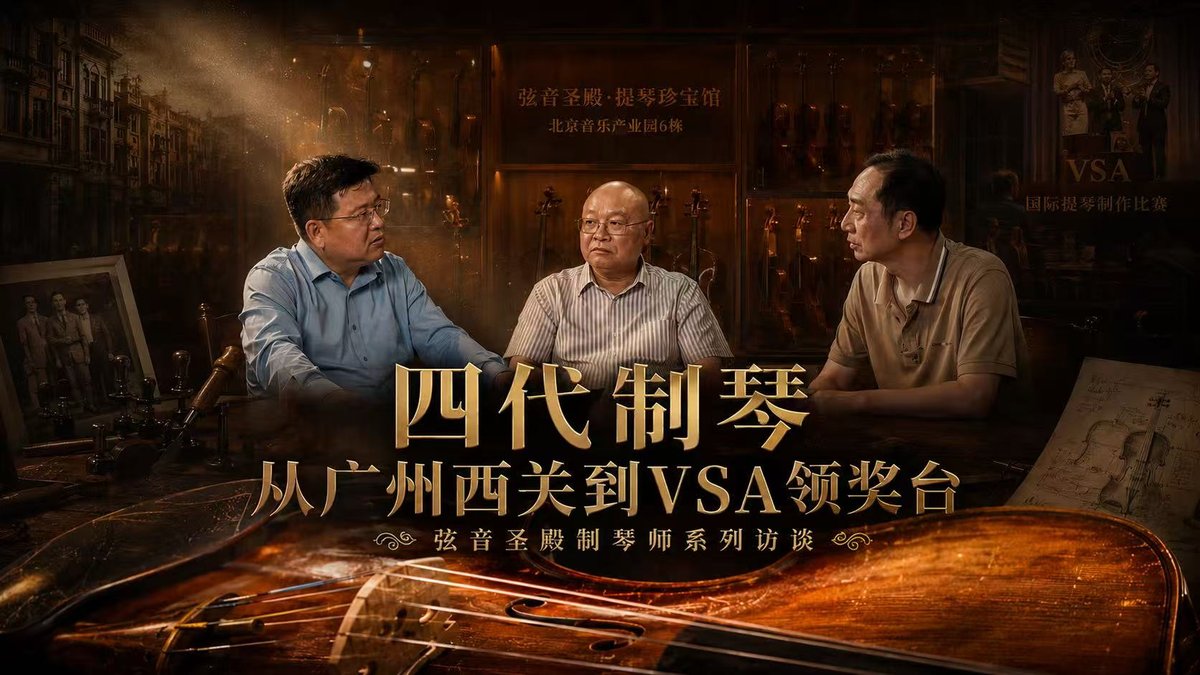
首页/Interviews/Violin Temple · Violin Temple Treasure Hall First Interview: This episode features Master Liang Zhiling and his son, from a four-generation luthier family.
Violin Temple · Violin Temple Treasure Hall First Interview: This episode features Master Liang Zhiling and his son, from a four-generation luthier family.
Interviews管理员June 3, 2026
Four Generations of Luthier Heritage, Nearly Unmatched in China: Starting from Xiguan, Guangzhou in 1935
In China's lutherie industry, family heritage extending to the fourth generation is, as far as Liang Zhiling knows, almost nonexistent.
"There might be two generations, but three or four are very rare. Abroad, in Italy, Germany, and France, there are more—some lineages dating back to the 1800s. In China, even two generations are relatively uncommon."
The starting point of this lineage is Xiguan, Guangzhou, in 1935. Liang Zhiling's maternal grandfather, Mr. Huang Da, established a violin workshop there. In that era, Xiguan and the Thirteen Hongs area of Guangzhou were concessions, where many British, French, and American businessmen came, bringing violins and guitars. When strings broke or glue came undone, they would bring the instruments to Huang Da's workshop for repairs.
"My grandfather thought these instruments were good, so he studied them by reverse-engineering. It started with repairs—while fixing them, he observed their shape, measurements, thickness, and gradually began making them himself," Liang Zhiling said. "I truly admire them, my ancestors of that generation—it seemed like they could learn just by looking."
Violinist Hao Li added context about that era: "Truly detailed blueprints and more scientific materials only came into China in recent decades. In the past, China had no complete violin-making system. When we were kids, the violin shapes we saw might have been drawn on newspaper; even the f-holes were sometimes made by poking holes with a needle."
In 1954, Huang Da's workshop merged with seven others to form the Nanlian Musical Instrument Factory, the predecessor of the Guangdong Musical Instrument Factory (Kapok Factory). Liang Zhiling's parents also worked in instrument making. Liang Zhiling himself is the third generation, and his son, Liang Zhenyu, is the fourth.
"Because this craft is still tough and labor-intensive," Liang Zhiling said. "I know many luthiers whose parents are still making instruments, but their children have mostly switched careers or gone into other fields. Passing it down is very difficult."
Liang Zhenyu's entry into the craft was not driven by passion from the start. "When I was in middle and high school, I wasn't particularly interested in anything," he recalled. "Later, I followed my father to the factory, starting with sharpening knives." Along the way, he doubted whether this path had a future, until he gained recognition in the industry. "Once you achieve a sense of accomplishment in this work, it creates a positive cycle, and you grow to love it more and more."
"It wasn't an innate passion from the beginning," Liang Zhenyu said. "Most of the time, the sense of mission comes gradually through the process of working."
From 1935 to 2026, nearly a century, four generations, the same craft. In China, this in itself is a rarity.