What exactly is the difference between a 300-dollar violin and a 300,000-dollar violin? | Violin Temple | Violin Temple
首页/Guides/What exactly is the difference between a 300-dollar violin and a 300,000-dollar violin?
What exactly is the difference between a 300-dollar violin and a 300,000-dollar violin?
Guides田立夫June 17, 2026
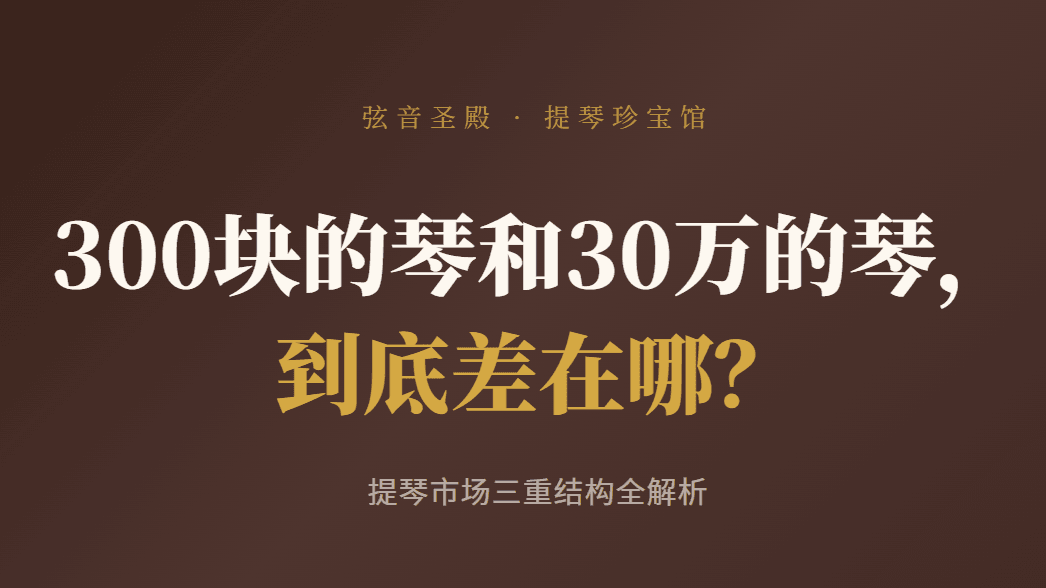
Many people feel overwhelmed when first encountering the violin market — why are some instruments that look just like a violin priced at a few hundred yuan while others cost hundreds of thousands? Isn't that just a tax on ignorance?
Violin Temple · Violin Temple Treasure Hall
A 300-dollar violin vs. a 300,000-dollar violin—
What’s the real difference?
A complete breakdown of the three-tier violin market
Many people are baffled when they first encounter the violin market—why do some instruments that look the same cost a few hundred bucks while others go for hundreds of thousands? Is it just a tax on ignorance?
Not at all. The violin market is highly stratified. Three tiers of instruments correspond to three completely different production logics, material standards, and user needs. If you don’t understand this structure, you’ll likely waste your money.
Today, let’s break it down.
### Tier One
**Factory Violins—300 to 1,000 RMB, "Good Enough"**
Factory violins, as the name suggests, come off an assembly line. Materials aren’t a priority—some even use plywood. Their core logic is simple: cheap.
Annual production runs into hundreds of thousands. Who buys them? Mostly school orchestras abroad. In the U.S., Australia, and Europe, students in school ensembles typically use these. They’re good enough to start, and you won’t cry if they break. That’s their purpose.
In China, the price range is roughly 300 to 1,000 RMB. Are there good ones at this price? Yes, but it’s a gamble. Factory violins vary wildly in quality—even from the same batch, one might have decent tone, while another sounds like a saw. It’s not a craftsmanship issue; it’s cost-driven. At this price point, individual adjustment is impossible.
Factory violins are standard starter instruments abroad, but in China, you don’t really need to buy one. Why? Because there’s a better starting option: renting. For example, Idyllic Symphony offers violin rentals for 50 RMB a month. These aren’t factory violins—they’re mass-produced handmade instruments worth over 2,000 RMB. For 50 RMB a month, you get a far better experience than buying an 800 RMB factory violin.
Better mass-produced handmade violins have bright, easy-to-produce sound—crucial for beginners. Whether a violin is easy to play directly determines if a child wants to continue learning. Factory violins struggle here, not from lack of intent, but from cost constraints.
So, Chinese parents don’t need to rush into buying a factory violin. Renting a better one is more cost-effective and hassle-free.
Factory violins aren’t for "appreciation"—they’re for "starting." But in China, even that start has a better option: renting a mass-produced handmade violin beats buying a factory one.
◆ ◆ ◆
### Tier Two
**Mass-Produced Handmade Violins—1,000 to 20,000+ RMB, the Most Misunderstood Tier**
This tier is where people get burned the most, and it’s worth explaining thoroughly.
First, pricing. Fractional violins (3/4, 1/2, etc.) typically range from just over 1,000 to 5,000 RMB. 5,000 RMB is the ceiling for fractional violins in China—no exceptions.
A fractional violin is used for about a year before the child outgrows it. Who would buy a tens-of-thousands-yuan fractional violin? So Chinese luthiers don’t make them—they wouldn’t sell.
If someone recommends a fractional violin for 10,000, 20,000, or more, you’re likely being ripped off. There’s no rational pricing logic for that in the fractional market. Any extra money doesn’t go into the instrument.
Full-size violins have a much wider range, from over 2,000 to 20,000+ RMB.
What defines a mass-produced handmade violin? Fixed models. A luthier or workshop sticks to one or two standard models—say, a 1721 Stradivari or a 1742 Guarneri del Gesù. No variations.
Why fixed models? Because once the model is set, tasks can be divided—someone makes only scrolls, someone only top plates, someone only purfling. Efficiency goes up, costs come down.
Key insight: Mass-produced handmade ≠ inferior.
A top luthier using premium materials, working on a fixed model with divided labor—costs drop, but tone and craftsmanship don’t. So at 20,000–30,000 RMB, you can still find exceptional instruments in this tier.
The real difference between mass-produced handmade and fully handmade isn’t "good vs. bad"—it’s "fixed vs. flexible." Mass-produced handmade violins have locked-in models. If you want different parameters or shapes, they can’t do it. But if you want that classic model, they can deliver excellence.
Mass-produced handmade violins offer the best value for "serious instruments." Pick the right model and luthier, and 20,000 RMB can buy 50,000-level tone.
◆ ◆ ◆
### Tier Three
**Fully Handmade Violins—30,000 to 300,000 RMB, the Luthier’s Freedom and Limit**
This is the pinnacle of the violin market.
A fully handmade violin starts from a block of wood, carved stroke by stroke by a single luthier. Scroll, top plate, purfling, f-holes—every step is done in-house, no outsourcing.
Its biggest advantage? Freedom.
No need to stick to any fixed model. Want a Stradivari outline with Guarneri f-holes? Done. Want the body slightly wider or thinner? Done. Want to adjust f-hole size, arching, or thickness? All possible. The luthier tailors it from wood to finished instrument based on your needs.
Materials are, of course, top-tier. Only the most skilled luthiers in the industry make fully handmade violins.
Pricing? For Chinese luthiers, 30,000 to 300,000 RMB. Why such a wide range? Because "fully handmade" includes several variables:
- Material grade: The same spruce from a sunny vs. shady slope, or a 100-year vs. 300-year tree, can differ in price by multiples.
- Finish quality: Some violins are polished to near perfection; others are more roughly finished.
- Luthier track record: This is the biggest variable. A violin that won a competition vs. a luthier’s daily output can have vastly different prices. There’s also the type made to competition standards but not entered—equally high quality but pricier.
With a fully handmade violin, you’re not just buying an instrument—you’re buying the luthier’s time, judgment, and creativity. Each one is a unique piece.
◆ ◆ ◆
### The Overlooked Truth
**Chinese Luthiers: The World’s Biggest Value Gap**
Speaking of pricing, one market phenomenon deserves special mention.
Price comparison for same-grade fully handmade violins:
Chinese luthiers: 30,000–300,000 RMB
European/Italian luthiers: ≈ same grade × 3
A 1,000 RMB Chinese violin → U.S. market: 1,000 USD
A 1,000 RMB Chinese violin → Australian market: 1,000 AUD
Same grade = identical tone, craftsmanship, and materials. The price gap comes from brand premium, geographic halo, and market inertia—not quality differences.
What does this mean?
Chinese luthiers at every market tier represent a massive value misalignment. Factory violins offer value, mass-produced handmade violins offer value, and fully handmade violins are severely undervalued.
This isn’t a "cheap means bad" story—it’s the biggest information gap in the global violin market.
◆ ◆ ◆
### Buyer’s Guide
**You Might Be Overpaying, Not Because the Violin Is Expensive**
After understanding the three-tier structure, there’s another reality: many people pay more than the violin’s market price. Where does the extra money go?
First, channel markup—rent-seeking.
Some teachers recommend a violin to a student with a significant markup. This money has nothing to do with the violin’s quality or the luthier’s skill—it’s pure exploitation of information asymmetry. You might pay 8,000 RMB for a 4,000 RMB mass-produced handmade violin. The difference doesn’t go into the instrument; it goes into "not knowing better."
This isn’t a small issue. Violins aren’t smartphones—you can’t compare specs. Ordinary people can’t judge a violin’s true value. The bigger the information gap, the more room for middlemen to profit.
Second, rent for physical stores.
Opening a violin shop in a prime commercial area or music street costs hundreds of thousands to millions in annual rent. Violins aren’t fast-moving goods—you sell a few a month, but rent is non-negotiable. How do you cover costs? By adding them to the violin’s price.
So, a violin in a physical store might have 30% or more of its price tied to rent. This isn’t greed—it’s business model reality: high rent + low turnover = expensive violins.
These two issues together are what most need to change in the violin market. The extra money consumers pay doesn’t go to the luthier or improve the violin. It goes to middlemen and landlords.
◆ ◆ ◆
### Back to Basics
**What Kind of Violin Do You Need?**
Understanding the market structure ultimately answers one question—what are you buying a violin for?
**Child just starting, unsure if they’ll stick with it**
Don’t buy a factory violin. Rent a mass-produced handmade one.
Better experience, lower cost. A 50 RMB/month rental uses a 2,000+ grade mass-produced handmade violin—far better than buying an 800 RMB factory one.
**Serious student for a few years, needs a violin worthy of practice**
Mass-produced handmade violin.
Choose the right model and luthier for the best value. 20,000 RMB can buy 50,000-level tone.
**Specific sound preference, collecting or investing**
Fully handmade violin.
Find the right luthier; every yuan goes into customization. 30,000–300,000 RMB, each one unique.
Make your money truly go into the violin.
The market doesn’t lie, but information asymmetry does. Three tiers, three logics—mix them up, and you pay for someone else’s information gap.
Violin Temple · Violin Temple Treasure Hall
Let every violin find its rightful owner
violintemple.com