首页/Interviews/After thirty years of making violins, I dare not claim to truly understand them. Yang Jinlong: One of the few Chinese luthiers to win consecutive VSA international competitions.

After thirty years of making violins, I dare not claim to truly understand them. Yang Jinlong: One of the few Chinese luthiers to win consecutive VSA international competitions.

Interviews提琴珍宝馆管理员July 5, 2026
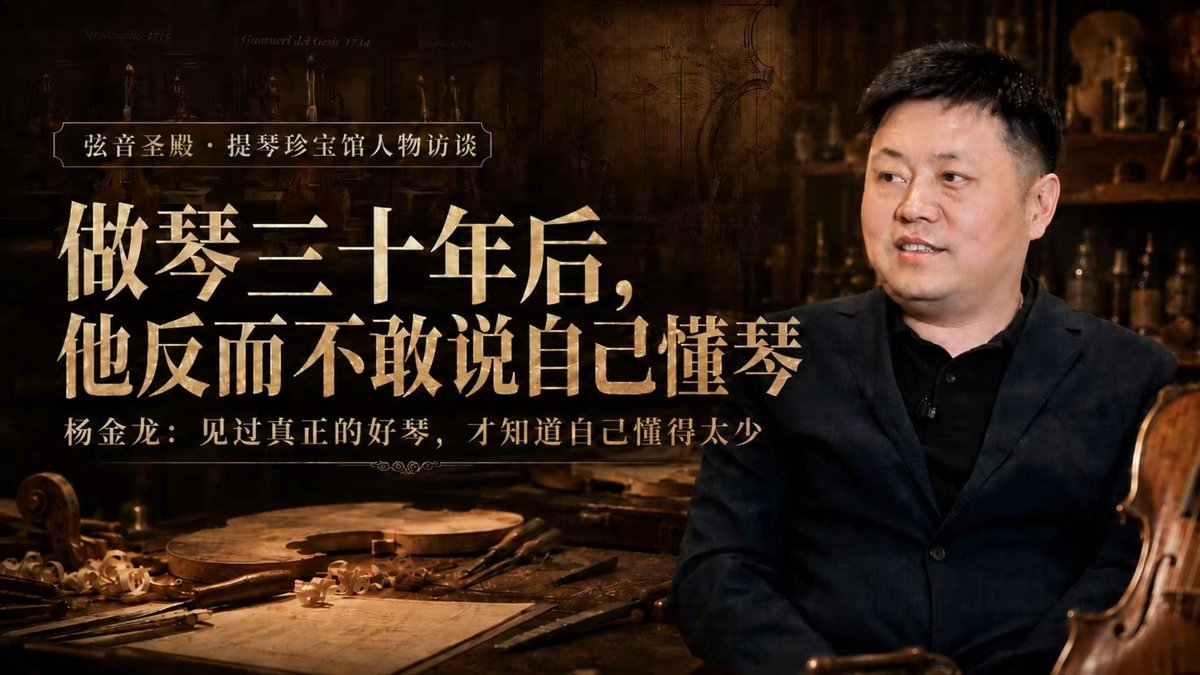
After thirty years of making violins, I dare not claim to truly understand them. Yang Jinlong: One of the few Chinese luthiers to win consecutive VSA international competitions.

Yang Jinlong entered the craft in 1996, making it exactly thirty years now. He is one of the few Chinese luthiers to have consecutively won awards at the VSA International Violin Making Competition in the United States—silver medal for violin in 2016, cello tone award + viola workmanship award + quartet workmanship award in 2018, and silver medal for viola workmanship + quartet workmanship award in 2024. With over thirty international and domestic awards to his name, he instead says he is "especially lacking in confidence."

VIOLIN TEMPLE Luthier Notes Idyllic Symphony · Luthier’s Journal After thirty years of making violins, I dare not say I truly understand them. Yang Jinlong: One of the few Chinese luthiers to win consecutive VSA international awards. In my first ten years, I thought my work was excellent and felt very confident. After twenty years, I lost that confidence. The more fine instruments I encountered, the more I realized the gap between my understanding and true excellence. — Yang Jinlong Yang Jinlong entered the craft in 1996, now a full thirty years. He is one of the few Chinese luthiers to win consecutive awards at the VSA International Violin Making Competition—silver for violin in 2016, cello tone award plus viola workmanship award and quartet workmanship award in 2018, and viola workmanship silver plus quartet workmanship award in 2024. With over thirty international and domestic awards to his name, he instead says he is "particularly unconfident." First decade: technique; second decade: enlightenment Yang Jinlong says violin making has two stages—the first ten years focus on hand skills, and the decade after focuses on deep understanding of sound. The latter requires "enlightenment." If you haven't achieved enlightenment, even after twenty or thirty years, you remain at the level of the first decade. The first decade relies on technique—you can standardize arching, set thickness precisely, and adjust assembly accurately. But after ten years, technique is no longer the bottleneck. "Understanding of violin making changes at every stage. Even now, I dare not think my violins are truly good." Ultimately, violin making is not about hand skills but about the heart's understanding of the instrument. First enlightenment: repairing a French Lupot Yang Jinlong's several enlightenments all came from "seeing the real thing." The first was repairing a French Lupot violin—the top plate was severely damaged and needed replacement. He traced the original outline with a beard brush, and when recreating the arching, he discovered that Lupot's arching differed from his own understanding: "Our arching is too monotonous. Lupot's arching has many variations—it's not a fixed curve. Most domestic luthiers make arching too standardized and simple—but after this stage, I gained understanding of arching. I modify it every time, searching for the feeling. The arching of a fine violin is not a fixed formula; each must be adjusted according to the wood and concept. That's why a true luthier cannot make many violins at once." Second enlightenment: touching real violins at the VSA The second enlightenment came at the VSA competition in the USA. There were over a dozen authentic famous violins—Stradivari, Guarneri—all available to hold and examine. He had attended competitions before but "skimmed through and left." This time, he didn't win an award and felt disappointed, so he stayed, constantly observing and comparing. "I saw Guarneri's violins—they seemed casual, but I didn't find them rough. For example, one f-hole was larger than the other—not because he couldn't make them the same size (that's easy), but because he felt it improved the sound. And there was an aesthetic pursuit: asymmetry." Yang Jinlong has imitated Guarneri's violins several times. Through imitation, he began to understand: Guarneri's "casualness" is a deliberate freedom—like calligraphy, a master's cursive may look messy, but every stroke has its reason. Can laser-cut arching produce good violins? Now, arching from fine violins can be laser-scanned and directly cut by machine. Can this produce good violins? "No problem for beginners. But true masters won't use it this way. Even if you follow mature arching data, it's hard to achieve good sound. Why? 'Because every violin is not exactly the same. No two violins—whether in arching or thickness—are identical. If they were, it would be like photocopying a photo—no difference—and that's definitely wrong.'" A violin is not an industrial product. Each piece of wood has its own temperament; each violin has its own character. Data can be copied, but understanding cannot. Varnish cost: what's washed off is money Many people can't calculate the cost of a handmade violin. Yang Jinlong discusses one of the most overlooked parts—varnish. He used to make his own varnish, boiling resin with heavy smoke, impossible in a residential area. Now he buys ready-made Italian varnish, the most expensive over a thousand USD per small can—ten to a hundred times the cost of domestic varnish. But the varnish itself isn't the biggest expense. If the effect is unsatisfactory, it must be washed off and redone. "For cellos, washing five or six times, even seven times, is normal. For violins, ten or eight times is very common. So it's possible that after selling the violin, the cost doesn't even cover the varnish. That's why truly good handmade violins can't be cheap. Each coat of varnish costs money, and each wash-off costs money too. Domestic factories make their own varnish not because their formula is better, but because the cost of washing off varnish is too high." · · · After thirty years of making violins and winning over thirty awards, Yang Jinlong says, "I make fewer and fewer, fewer and fewer." He makes less but thinks more. At the 2026 Idyllic Symphony auction, his violin had a starting price of 70,000, estimated at 90,000 to 150,000, and finally sold for 115,000. This price is the market's answer with real money—circulated value is true value. "It's not about me naming a price. You have to let it circulate in the market. If I say 200,000, and he buys it and sells it for 50,000 tomorrow—does that feel like 200,000?" Technique can be pursued, but understanding takes time. Thirty years, Yang Jinlong has gone from "thinking my work is excellent" to "particularly unconfident"—precisely the most mature state of a luthier. Yang Jinlong's violin works are now housed at the Idyllic Symphony · Violin Temple Treasure Hall. Welcome to visit and appreciate. Appreciation Inquiries Phone: +86 19910221529 Email: fredtaylor@coze.email Address: Building 6, Music Industrial Park, Chaoyang District, Beijing violintemple.com Idyllic Symphony · Violin Temple Treasure Hall | violintemple.com