弦音圣殿弦音圣殿
HomeCollectionFine BowsMastersTradingProductsPre-OwnedAccessoriesRentalsRepairsOrchestraAbout中文
Violin TempleViolin Temple

China's largest exhibition and appraisal center for award-winning violin makers. Dedicated to the collection, exhibition, and trading of fine classical string instruments, delivering exceptional service to music lovers.

Products

  • Collection
  • Fine Bows
  • Masters
  • Trading
  • Products
  • Pre-Owned

Services

  • Accessories
  • Rentals
  • Repairs
  • About

Contact Us

  • 📞 +86 19910221529
  • ✉️ fredtaylor@coze.email
  • 📍 北京市朝阳区音乐产业园6栋迪贝斯音响馆

© 2026 弦音圣殿 Violin Temple. All rights reserved.

京ICP备2026024174号

首页/News/Chinese High-End Violins: Why Will the Instruments of This Generation of Luthiers Become Increasingly Valuable in the Future?

Chinese High-End Violins: Why Will the Instruments of This Generation of Luthiers Become Increasingly Valuable in the Future?

田立夫July 31, 2026
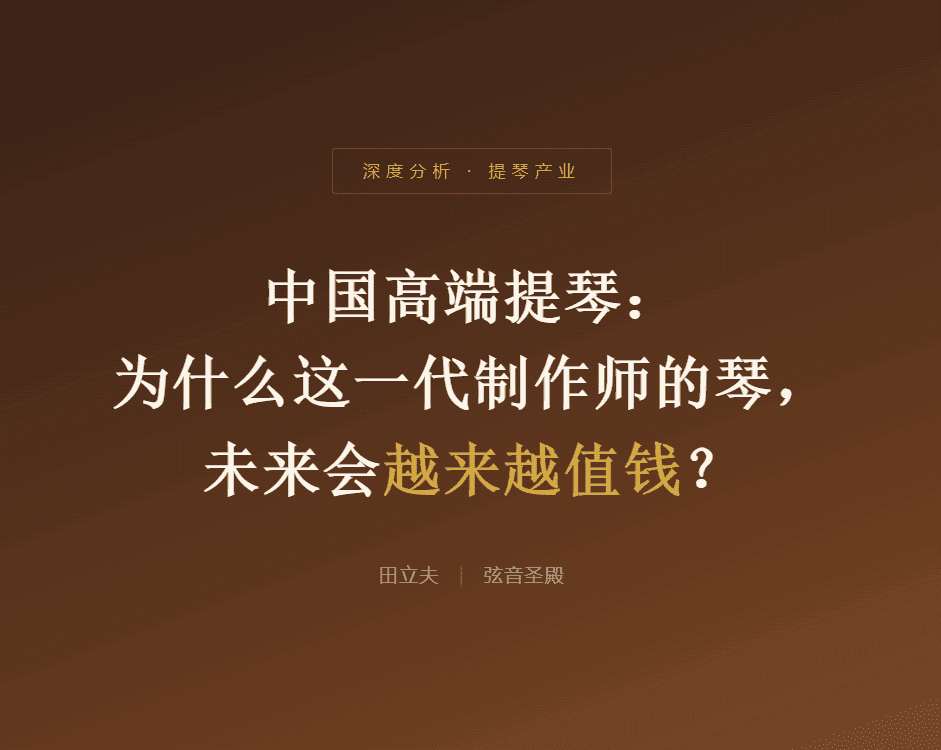
Chinese High-End Violins: Why Will the Instruments of This Generation of Luthiers Become Increasingly Valuable in the Future?

The key point is: the core group of luthiers supporting this vast industry largely grew up in the 1980s-1990s. And among their second generation, very few are willing to take over the family craft.

In-Depth Analysis · The Violin Industry China's High-End Violins: Why Will the Instruments Made by This Generation of Luthiers Become Increasingly Valuable in the Future? Tian Lifu | Violin Temple A Set of Figures Few Have Noticed China is the world's largest violin-producing country. The town of Huangqiao in Taixing, Jiangsu Province alone produces approximately 40% of the world's violins, with a domestic market share exceeding 70% (according to a June 2026 report by People's Daily Online). Zhugou Town in Queshan, Henan Province produces over 400,000 handcrafted mid-to-high-end violins annually, accounting for more than 80% of China's mid-to-high-end handcrafted violin market share. Its products are exported to more than 30 countries, including the United States, Germany, Italy, and France. In 2025, customs supervised exports of Queshan violins exceeded 30,000 units, with a total value of 28.22 million RMB. 40% Huangqiao Town's share of global violin production 4.28 Billion RMB China's violin industry market size in 2026 7.85 Billion RMB Projected market size in 2031 But production volume is not the point. The key point is this: the core group of luthiers supporting this vast industry largely grew up in the 1980s and 1990s. And very few of their second-generation children are willing to take over the craft. What does this mean? It means that the violins produced by this current generation of Chinese luthiers are very likely the "peak works" of Chinese violin-making. And peaks are often impossible to replicate. A Century of Shifts in the Violin Industry: From Cremona to China To understand the value of Chinese violins, one must first recognize a pattern: the center of violin-making has continuously shifted internationally. In the 17th and 18th centuries, Cremona, Italy, was the absolute center of world violin-making. Stradivari (1644-1737) and Guarneri del Gesù (1698-1744) crafted the finest violins in human history during that era. The prices their instruments command today—Stradivari's "Baron Knoop" (made in 1715) sold for $23 million in March 2025, setting the highest auction price ever for a violin; Guarneri's "Vieuxtemps" (made in 1741) sold privately for approximately $16 million—are comparable to top-tier works of art. According to the violin investment analysis report published by Bein & Fushi, the long-term compound annual growth rate (CAGR) of Italian antique violins exceeds 10%, remaining resilient even during global economic downturns. Take the "Baron Knoop" as an example: purchased for $2.75 million in 1992 and resold for $23 million in 2025, it appreciated approximately 7.4 times over 33 years, with a CAGR of about 6.7%. From the 19th century to the early 20th century, France (especially Vuillaume in Paris) took over part of the function as a violin-making center. In the mid-20th century, Germany (Mittenwald, Markneukirchen) and Japan successively became important violin-manufacturing countries. Japan was a major supplier of mid-to-high-end violins globally in the 1970s and 1980s, but as labor costs rose and younger generations changed careers, Japan's violin-making industry shrank dramatically. Then came China. In 1985, the national violin output was only about 35,000 units, with exports accounting for 12%. By 1995, Huangqiao alone had surpassed 100,000 units. According to Zheng Quan's 2019 article in People's Daily Overseas Edition, China's violin output had reached 70% of the global total. China has approximately 350 senior luthiers and about 1,200 intermediate luthiers, forming three major industrial clusters represented by Pinggu in Beijing, Huangqiao in Taixing, Jiangsu, and Zhugou in Queshan, Henan. This pattern of shifting tells us one thing: the transfer of the violin-making industry never happens overnight. It requires the accumulation of one generation and the decline of another. China's "Golden Generation": From the Fields to Cremona The rise of Chinese violin-making is not an abstract industrial story; it is the story of specific people. The most representative figure is Zheng Quan. In 1983, at the age of 33, he was sent by the Ministry of Culture to study at the International Violin Making School in Cremona, Italy. In 1987, he won the gold medal for violin at Italy's First National Violin Making Competition—the first time a Chinese person achieved the highest international honor in this field. After returning to China in 1988, he established a 10-year violin-making teaching system at the Central Conservatory of Music, spanning from the affiliated middle school to graduate level, and over 30 years trained nearly 200 violin-making professionals. Today, six conservatories across the country have established violin-making programs. Zheng Quan is the benchmark, but he is not alone. In Huangqiao, Xu Xiaofeng, a former soldier, was admitted to the Shanghai Conservatory of Music in 2001. After returning to his hometown, he became a nationally certified senior luthier, mentoring nearly 60 apprentices and training over 2,500 farmers in the craft. In Queshan, Wang Jintang started as an apprentice in Beijing in the 1980s and cultivated the entire "Queshan masters" community—at its peak, more than 2,000 people worked in Beijing's violin industry. He returned to his hometown to start a business in 2015, and today Queshan boasts over 160 violin enterprises employing nearly 3,000 people. These people share a common trait: they entered the trade during an era of extreme material scarcity, relying purely on the accumulation of craftsmanship and time investment, progressing step by step from apprentice to master. Their professional experience generally exceeds 20 or even 30 years. This is not an isolated case in China's violin industry but the typical profile of the backbone group. This density of experience is extremely rare in the global history of violin-making. The Problem: Who Will Take Over? But there is a stark reality here. The situation in Queshan County is highly representative. Wang Jintang is now 57 years old, and he says, "My generation can no longer easily give violins their own names." Across the county, only about 60 of the "second-generation violin makers" have received formal professional music training. Yet the base number of first-generation luthiers is over 2,000. <3% Queshan's second-generation succession rate ~60 people Second-generation makers with professional training 2,000+ First-generation luthier base The deeper issue is this: the children of the older generation of luthiers have generally chosen to "leave"—to pursue education, change careers, or enter finance and IT. Not because they don't love the instrument, but because violin-making is a craft that demands extreme patience, has a long income return cycle, and enjoys low social recognition. Wang Jintang himself has said: "Making violins is a fine, skilled craft." But "fine" and "skilled" have limited competitive appeal in today's career choices. Queshan has already tried to address this: shortening the training period from 3 years to 3 months to get newcomers into the workforce quickly, and sending "second-generation makers" to music conservatories at home and abroad for advanced study. But this solves the problem of "quantity." High-end violin-making requires "quality"—that feel honed over 20 to 30 years, the intuitive judgment of wood and tone—which cannot be rushed. So the reality is this: this generation of Chinese high-end violin makers is very likely the peak of Chinese violin-making. Both Supply and Demand Are Tightening Simultaneously Having understood the supply side, let us now examine the demand side. The number of children learning the violin in China continues to grow. According to industry data, the domestic violin market size in 2025 exceeded 2 billion RMB for the first time, a year-on-year increase of 15%, with handcrafted custom violins achieving a CAGR of 22%. Professional conservatory students account for 65% of demand for high-end instruments, and first-tier cities account for 42% of demand. Meanwhile, professional orchestras are also shifting to domestic instruments. As Zheng Quan put it: "In the early days of reform and opening up, our musicians went abroad to compete and discovered that the violins in their hands were completely inadequate for performance standards. Now, most domestic symphony orchestras, including the China Central Symphony Orchestra, use domestically made violins." Supply is contracting (the older generation of luthiers is non-renewable, and the second-generation succession rate is extremely low), while demand is growing (an expanding population of violin students and orchestras upgrading their instruments). This is the most classic logic of appreciation. Japan's Cautionary Tale Some might ask: isn't industrial relocation the norm? If China falters, there are Vietnam and India. True, but there is a vast chasm between "being able to make them" and "making them well." Japan is the cautionary tale. In the 1970s and 1980s, Japan was a major global manufacturer of mid-to-high-end violins, with brands like Suzuki holding a considerable share of the European and American markets. But after the bubble economy burst, young people lost interest in entering the trade, and labor costs soared, Japan's violin-making industry contracted sharply. Today, the number of Japanese luthiers has drastically declined, and Japanese-made high-end violins circulating on the market have become "limited editions"—with second-hand prices actually rising. This precisely proves a pattern: when a country's "golden generation" of violin-making exits the historical stage, the instruments they leave behind are the final products of that era. China today stands at exactly this inflection point. The difference is that China's scale far exceeds Japan's—hundreds of senior luthiers honed over 20 to 30 years, violin-making programs at six conservatories, and an industrial base producing hundreds of thousands of mid-to-high-end violins annually. But the inflection point has already begun. Where Exactly Is the Appreciation Potential of Chinese High-End Violins? Having laid out the industrial logic, let us turn to the concrete question: what kind of violin should one buy for future value? First, the works of China's top contemporary luthiers. Zheng Quan currently makes only three or four violins per year. His market positioning is already very clear—"If someone is not an excellent player, or merely comes out of admiration without understanding the instrument, they will have to wait." This scarcity itself is the foundation of appreciation. Among the 350 senior luthiers nationwide, no more than 20 have international award backgrounds and decades of accumulated experience like Zheng Quan. Second, luthiers with international competition award credentials. The China International Violin and Bow Making Competition, founded in 2010 and held every three years, had completed five editions by 2024. The fifth edition attracted over 260 luthiers from multiple countries with 456 entries. Chinese makers Yu Huidong, Li Bin, and Zhao Junhai won gold medals for violin, viola, and cello respectively, while bow maker Xue Liang swept all three gold medals for violin bow, viola bow, and cello bow. Meanwhile, Chinese luthiers have repeatedly achieved outstanding results at Italy's Stradivari International Competition, the American VSA International Competition, and Italy's Pisogne Competition—in 2024, Liu Zhaojun won the silver medal for violin at the Stradivari Competition in Italy (with the gold medal left vacant), and Xia Zhenshan won the gold medal for modern viola at the Pisogne Competition. These award records are the "hard currency" for future market pricing. Third, the works of students of renowned masters. Zheng Quan has trained nearly 200 students distributed across the country. The most outstanding among them have already won international competitions. Their works are currently priced far below their teacher's, but the lineage is clear and the craftsmanship is verifiable. Fourth, young and mid-career luthiers whose quality is proven but who have not yet "broken through." The current average market price for high-end handcrafted violins exceeds 35,000 RMB, yet many works by highly skilled makers still fall in the 50,000–100,000 RMB range. According to Queshan luthier Wang Jintang, a violin he once sold for approximately 60,000 RMB, after rebranding and setup adjustments, was ultimately sold to an orchestra for as much as $200,000—a price difference of more than 20 times. This demonstrates that the quality of Chinese luthiers has already reached the required standard; what is lacking is brand recognition. Looking at the appreciation patterns of the international market: the works of 19th-century Italian maker Rocca are worth 500,000–700,000 euros today, and 20th-century Vuillaume instruments are worth 250,000–400,000 euros. These makers, during their active years, were priced at no more than a few years' income of the middle class. The works of China's contemporary top luthiers currently range from tens of thousands to over one hundred thousand RMB—if market recognition catches up and a brand system is established in the future, the appreciation potential is structural. But it must be emphasized: this depends on whether Chinese violins can establish an independent brand system and international discourse power, which is currently a work in progress rather than a completed achievement. Of course, this does not mean all Chinese violins will appreciate. Low-end mass-produced instruments have no collectible value. What truly has appreciation potential are the works of high-end luthiers with craftsmanship, lineage, award records, and limited output—and this generation is aging. In Closing Violin-making is a handicraft industry; it does not have the technological barriers of the chip industry. When a country's peak period of violin-making passes, the industry can entirely shift to the next cost lowland. But there is one difference: the instruments made by craftsmen are non-renewable. Stradivari has been gone for nearly 300 years, yet the approximately 600 violins he left behind remain top-tier lots in the global auction market. The current generation of Chinese luthiers may not attain Stradivari's historical status, but they are the witnesses and creators of the era in which Chinese violin-making went "from nothing to something, from weak to strong." Their instruments are the voice of China in this era. While they are still making violins, keep the good ones. This is not sentimentality. It is judgment. Data sources: People's Daily Online, "Marching China | Violins Play the 'Song of Shared Prosperity'" 2026.06; People's Daily Overseas Edition, "The Chinese Dream of a Fine Violin" 2019.05; China Musical Instrument Association, "2024 Report on the Development Status of China's Violin Industry"; Queshan County Government Violin Industry Report 2026.04; Huanghuai University, "Strings Connecting the World, Old Revolutionary Base Plays a New Tune—The Revitalization Code of the Violin Industry in Zhugou Town, Queshan" 2026.04; Dahe Caifang, "'Hometown of the Violin' Queshan: Two Generations of Luthiers and an Unfinished Movement" 2026.02; Bein & Fushi / Strad.biz, "An Overview of the Violin Investment Market"; The Strad Magazine 2025.03; Boyan Consulting, "2026 Research and Analysis Report on the Development Status and Market Share of China's Violin Industry"; Official Results of the 5th China International Violin and Bow Making Competition 2024.05 Violin Temple · Violin Temple Treasure Hall | violintemple.com © 2026 Tian Lifu · All Rights Reserved
← Back to Articles