Youth OrchestraJuly 30, 2026· 乐团场记
Left hand finds the first note. Beiyuan B-Level Orchestra, Lesson 3.
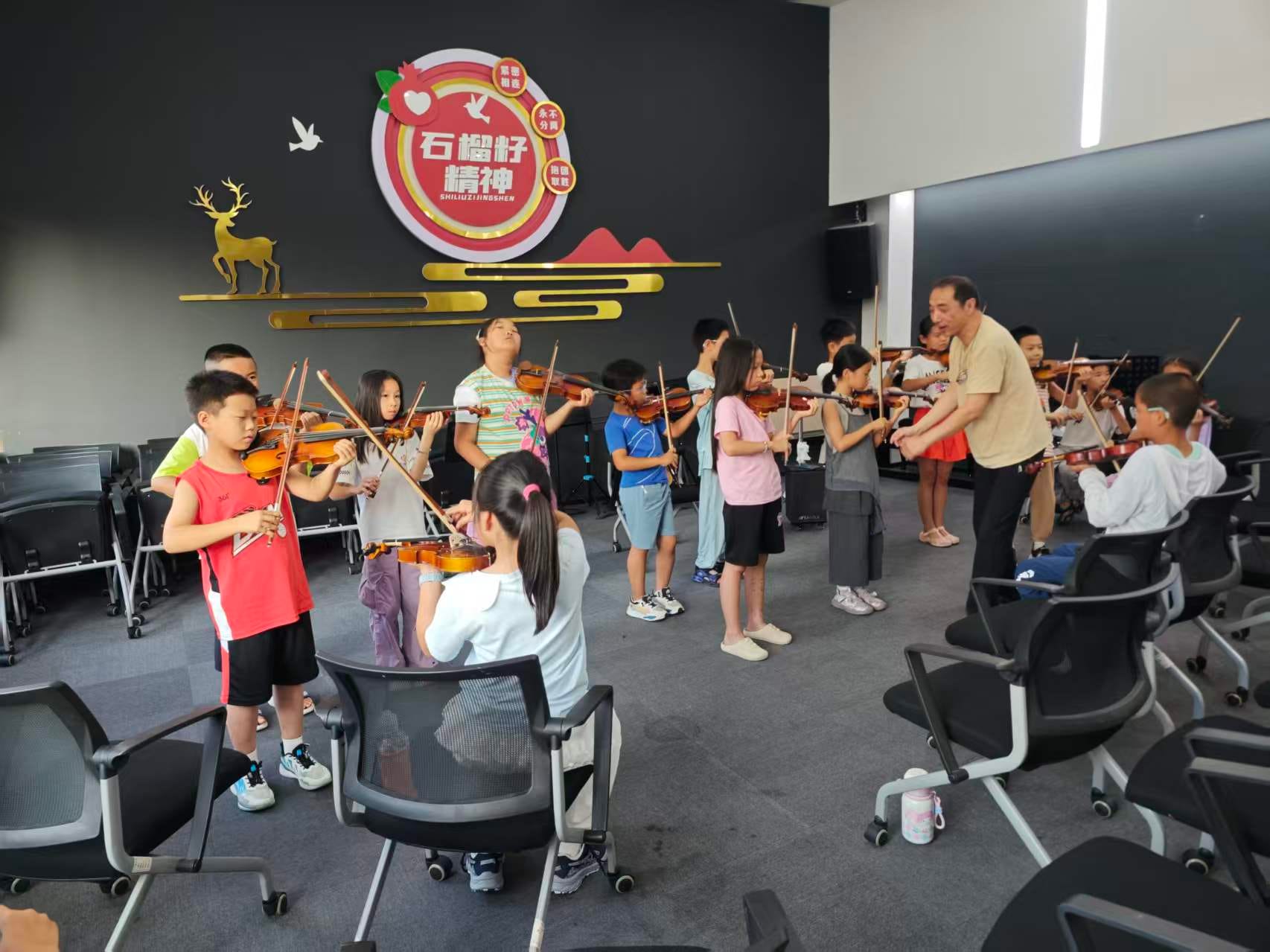
On the evening of July 28, the third lesson of the Idyllic Symphony Youth Public Welfare Orchestra's Level B ensemble was held at the Beiyuan Street Cultural Activity Center. Teacher Hao Li guided the children in taking their first steps in left-hand technique.
Idyllic Symphony Youth Community Orchestra
Left Hand Finds the First Note
Beiyuan B-Level Orchestra, Third Lesson
July 28, 2026 · Tongzhou Beiyuan
On the evening of July 28, the third lesson of the B-Level Orchestra of the Idyllic Symphony Youth Community Orchestra took place at the Beiyuan Street Cultural Activity Center. Teacher Hao Li guided the children through the first step of left-hand technique.
In the first two lessons, the children learned how to hold the bow, hold the violin, and play open strings in rhythm. These were all tasks for the right hand—responsible for producing sound. In this lesson, Teacher Hao began teaching the children to find the first note on the fingerboard with their left hand.
Pressing the strings with the left hand means the violin truly begins to "sing." Open strings, no matter how good, only offer the raw timbre of four strings. But the moment a left-hand finger lands on the fingerboard, the pitch changes, melody begins, and the children are no longer just producing sounds—they are playing notes.
· · ·
Finding the first note sounds simple, but for beginners with no prior experience, it involves a series of new movements: how to lift the left hand, where to place the finger, how much force to apply when pressing down, and what angle to maintain with the fingertip—every detail challenges the small muscles of the hand.
Teacher Hao’s approach remains consistent: not rushing for perfection, but first letting the child "reach." The finger position is roughly located first, while strength and angle will naturally refine through repeated practice. More important than perfecting the movement in one lesson is making the child feel: "I press down, the pitch changes—this is fun."
· · ·
A very normal phenomenon also appeared in this lesson.
In Class A of the B Orchestra, the older children had stronger finger strength and control, picking up the skill noticeably faster. In Class B, the younger children, whose fingers are still developing, were a beat slower in their movements; some still couldn’t find the correct position after several attempts.
This is determined by developmental stages, not ability. Younger children’s hand muscles are not yet fully developed, so their fine motor control is naturally weaker than that of older children. This isn’t "learning slowly"—it’s "the body is still preparing."
Teacher Hao noticed this difference in class and clearly told the children: Don’t compare with others. If your fingers are a little more obedient today than yesterday, that’s progress.
A note for parents: If your child comes home saying "I can’t press accurately" or "I can’t play well," please don’t worry. Finger strength and control take time to build. Every lesson brings progress, just at different paces. Encourage more, correct less, and keeping the child’s interest in the violin is more important than anything.
Regarding fingernails: In this lesson, we noticed that some children hadn’t trimmed their nails. Pressing strings with the left hand requires the fingertip to directly contact the fingerboard; overly long nails severely affect accuracy and feel. Before the next lesson, please ensure your child’s left-hand fingernails are cut short.
Regarding factory-made violins: During the lesson, we observed that some children using factory-made violins already had varying degrees of issues with strings, pegs, tailpieces, and shoulder rests. The vibration of the instrument was also less than ideal, which can indeed affect the child’s efficiency in learning and practicing. However, since they’ve already been purchased, they are still usable at the beginner stage. From another perspective, this is an opportunity for parents to learn how to maintain and adjust the instrument—parents who can repair violins will help their child’s learning journey go more smoothly.
Special reminder: Parents who bought factory-made violins are advised to replace the shoulder rest with a good-quality one as soon as possible. The shoulder rests included with factory violins are not only poor in quality but also flawed in design—they have sharp edges that can dig into the child’s neck, directly affecting comfort and focus during practice. A good shoulder rest is not expensive, but its impact on the child’s practice state is significant—this expense is worth it.
Course Information
Class time: Every Monday, 18:00–20:10
Instructor: Teacher Hao Li (violin)
Location: Beiyuan Street Cultural Activity Center (Second Floor, Yueshan Bookstore)
Suitable for: Beginners with no prior experience
Three lessons in, from not being able to hold the violin steadily to pressing the first note, the children have already crossed the initial threshold. The road ahead is still long, but they are on their way.
Idyllic Symphony Youth Community Orchestra · Bringing Good Music into Every Home