Youth OrchestraAugust 4, 2026· 乐团场记
Left hand third finger is here - Beiyuan B-Level Orchestra, fourth lesson
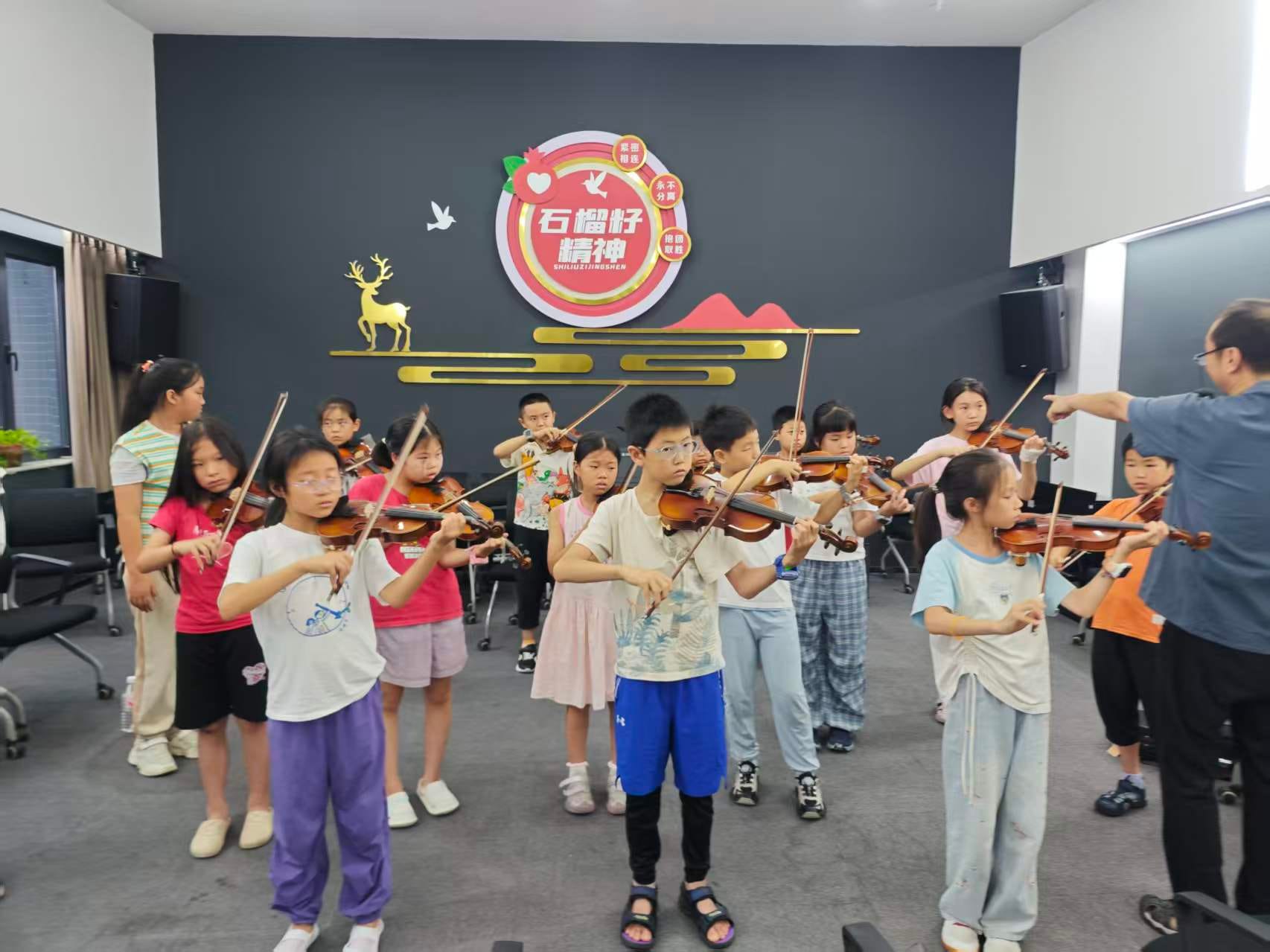
On the evening of August 3rd, the fourth lesson of the Idyllic Symphony Youth Charity Orchestra's B-level ensemble took place at the Beiyuan Street Cultural Activity Center. Teacher Hao Li continued to guide the children forward—this time, the third finger of the left hand arrived.
Idyllic Symphony Youth Public Welfare Orchestra
Left Hand Third Finger Arrives
Beiyuan B-Level Orchestra Fourth Lesson
August 3, 2026 · Tongzhou Beiyuan
On the evening of August 3, the fourth lesson of the B-Level Orchestra of the Idyllic Symphony Youth Public Welfare Orchestra took place at the Beiyuan Street Cultural Activity Center. Teacher Hao Li continued to guide the children forward—this time, the left hand third finger arrived.
After the practice of the previous three lessons, most children's bow holds had become very stable, and their bowing postures were already fairly standardized.
Looking back at the progress across these four lessons: the first lesson taught bow grip and instrument hold, the second lesson taught playing open strings in rhythm, the third lesson added the left hand second finger, and the fourth lesson added the left hand third finger. From zero to four lessons, the children could already find different notes on the fingerboard using three fingers.
· · ·
Some might wonder: why start teaching from the second finger, not the first?
This is Teacher Hao Li's special teaching method. The traditional approach starts from the first finger, adding one at a time; but Teacher Hao chooses to start from the second finger, then add the third. The advantage of this method is that—children can establish a natural, relaxed left hand frame from the very beginning, rather than learning one finger first and then tearing it down to rebuild. Once the hand frame is correct, subsequent learning is simply additive on top of that foundation, without detours.
Teacher Hao maintained his consistent style—not pursuing perfection in a single lesson, but first letting the children find the feeling, with precision to be refined gradually in later lessons. He walked back and forth across the classroom, bending down to help each child adjust finger placement one by one, correcting left wrist angles. Some children's third fingers went down, but their second fingers lifted up; some children pressed both fingers down, but with insufficient pressure, producing weak, airy tones. Teacher Hao remained patient, working through each child individually.
· · ·
Before class, Teacher Hao chatted with Teacher Tian about these children. He said something quite touching:
"The moment I think about seeing these children learn the violin shortly, I feel tremendous joy."
This was no mere pleasantry. Teacher Hao is a former solo violinist of the Central Philharmonic Orchestra, and now serves as the teaching director of Idyllic Symphony. He has taught professional students and guided amateur enthusiasts alike, but faced with a group of complete beginners averaging under ten years old, he becomes even more relaxed and joyful.
Perhaps it is because teaching a group of children who know nothing, starting from absolute zero, brings more fulfillment than correcting bad habits in someone who already knows how to play. Every lesson shows visible, tangible progress—in the first week they could barely hold the instrument steady, and by the fourth week they could press three fingers to produce different notes. This pace of progress is something rarely experienced when teaching professional students.
· · ·
Looking back at these four lessons, the greatest change in the children is not how many notes they have learned, but their attitude toward the instrument.
In the first lesson, many children held the violin with excitement but confusion—not knowing where to place their hands, not knowing how to move the bow. Now, most children automatically enter a "ready to play" state the moment they pick up the instrument: chin rest secured, bow held properly, posture set. This physical memory has been accumulated over four lessons.
Tonight, Teacher Hao noticed right away that the bow hold remained very stable, and the bowing movements had become fairly standardized. What does this show? It shows that what was taught in these four lessons was not something enjoyed in class and then forgotten—it has truly entered the children's bodies.
Course Information
Class Time: Every Monday 18:00 - 20:10
Instructor: Teacher Hao Li (Violin)
Location: Beiyuan Street Cultural Activity Center (Second Floor, Yueqingshan Bookstore)
Suitable for: Complete beginners
Four lessons, from zero to notes with three fingers. The road ahead is still long, but the children are no longer in a "touching the instrument" state—they have begun "learning the instrument."
Idyllic Symphony Youth Public Welfare Orchestra · Bringing Great Music into Every Home