Youth OrchestraSeptember 29, 2026· 乐团场记
Free Violin Lessons for Two Months, 80% of Families Quit One Class: Two Communities, Reflecting a Social Picture Worth Facing Squarely
In Huilongguan, as long as you persist in learning the violin, you can surpass 80% of your peers; whereas in another community, 50% of the children can easily surpass 80% of the children in Huilongguan.
Public Welfare Orchestra Social Experiment · In-Depth Observation
Two Months of Free Violin Lessons
One Class Lost Eighty Percent of Its Families
Two Communities, Reflecting a Social Picture That Demands Attention
September 2026
Running a free public welfare orchestra, what we record has never been just "another class held" or "another performance given." Attendance, attrition, who accompanies the children to practice, how far the children have progressed—behind these cold numbers lie the real living conditions of individual families.
This time, the numbers sting a little.
· · ·
I. Two Months: Nearly 20 Families Down to 3
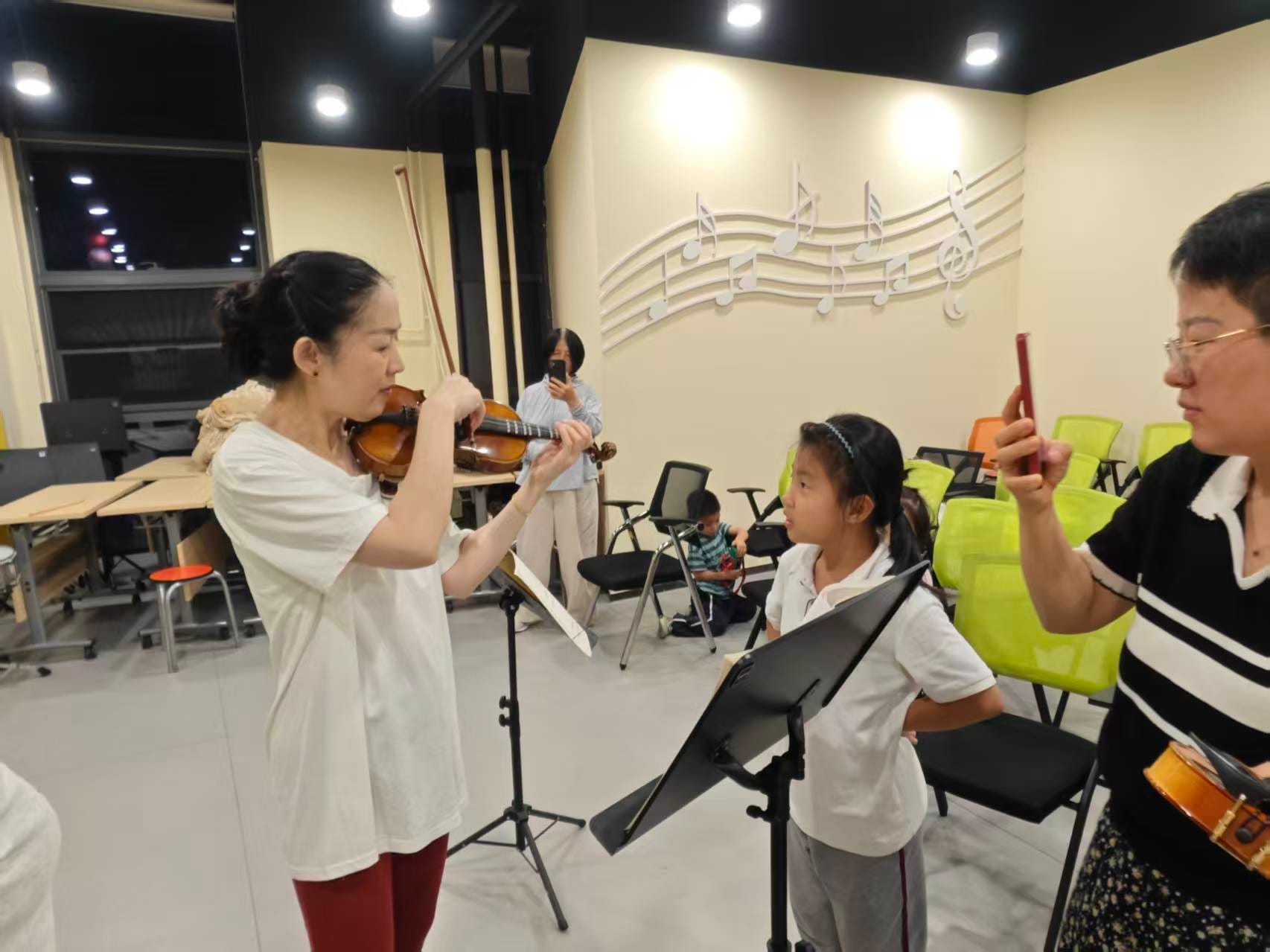
On September 23, at the Jin Yu International Community in Huilongguan, the B Orchestra beginner violin class was in session.
That day, only 3 families showed up—1 of them new to the class and about to start learning; the other 2 had asked for leave.
And just two months earlier, when this class first opened, there were nearly 20 families.
80%
Of the families in the free public welfare course at Jin Yu International Community
Failed to stick with it over two months
· · ·
II. The Same Two Months, Another Community
Shift the lens to Beiyuan Subdistrict in Tongzhou, and it's a different scene.
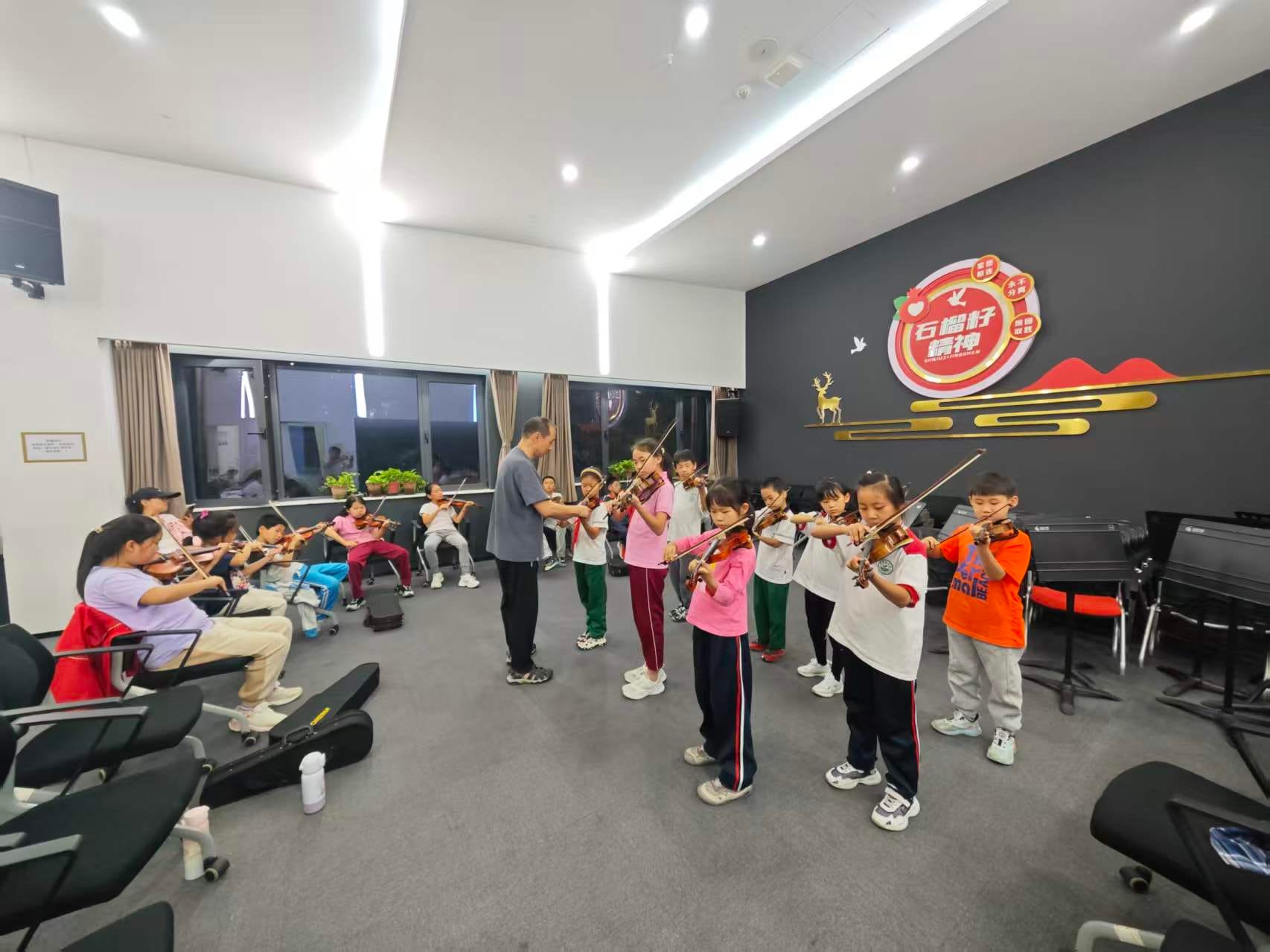 More than half the families in Beiyuan Subdistrict are attending classes steadily. The children who have persevered are now all playing "Twinkle Twinkle Little Star."
In Huilongguan's Jin Yu International, only 1 child has reached that point.
More than half the families in Beiyuan Subdistrict are attending classes steadily. The children who have persevered are now all playing "Twinkle Twinkle Little Star."
In Huilongguan's Jin Yu International, only 1 child has reached that point.
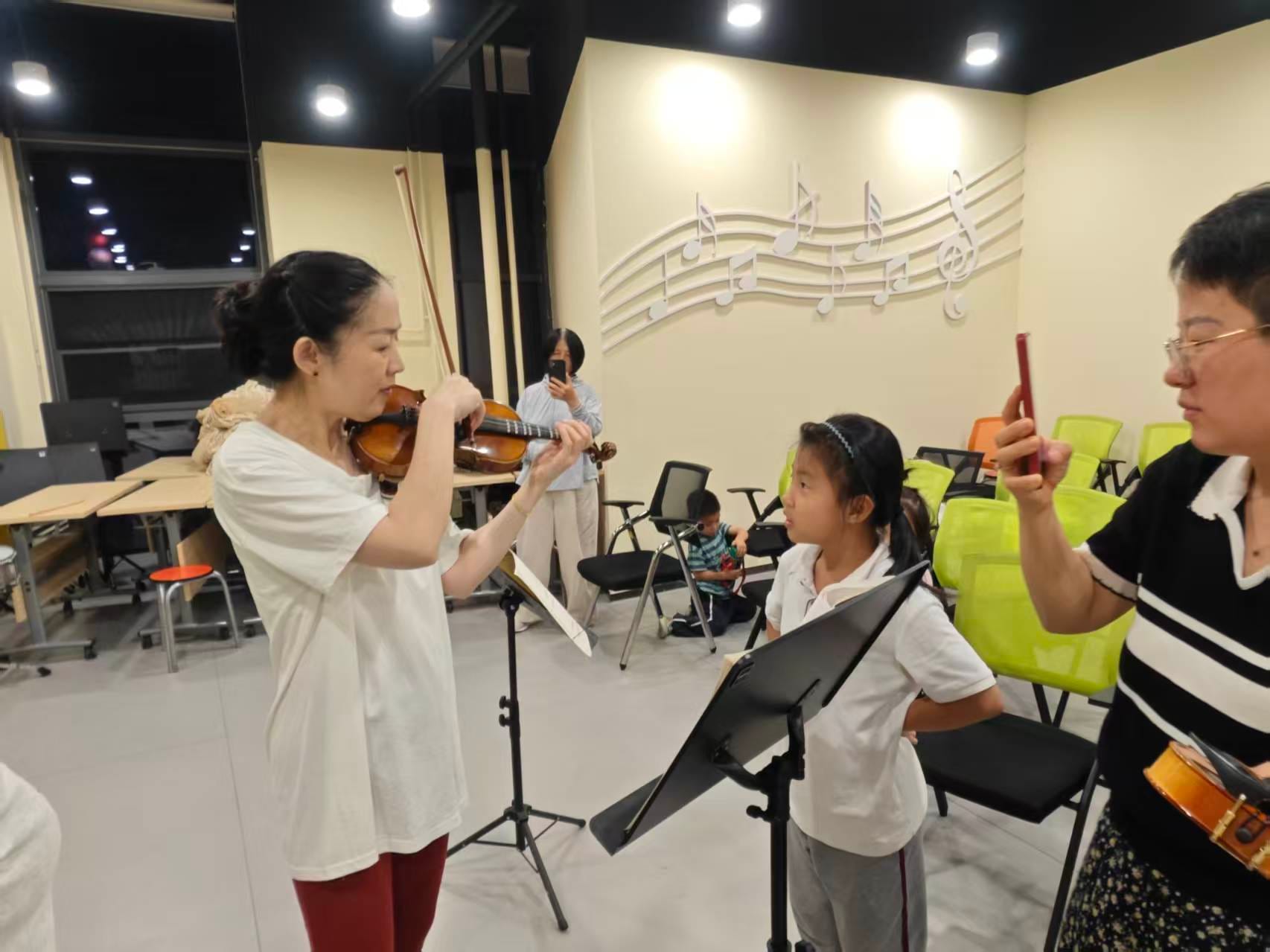 The same curriculum, the same teachers, equally free, the same two months—and the gap is laid out plainly for all to see.
· · ·
III. Eighty Percent of Children Experienced Failure Here
To be honest, this is a deeply saddening thing.
From an educational perspective, 80% of the children at Jin Yu International Community experienced failure in this free violin class—and the reason for that failure is not that the children are slow, nor that the teachers are poor, but that their families could not persevere.
The remaining 20% of children, by contrast, gain a precious positive experience: that if you simply persist in something, you can defeat 80% of your peers.
But we must clearly recognize: these "odds" themselves are abnormal.
Under normal circumstances, persisting in something means you only defeat 50% of people—just as in Beiyuan Subdistrict. In Huilongguan, you only need to persist a little to defeat 80% of people.
When "persistence" becomes a rare thing, those rewarded are certainly to be congratulated, but the children who left early, and the social problems exposed behind this, are what deserve our attention even more.
· · ·
IV. It's Not That Parents Don't Understand—They're Trapped
Please don't misunderstand: the parents in Huilongguan are precisely the group who understand the word "persistence" best.
Most of them, like me, came to Beijing from cities outside Beijing, fighting their way through the college entrance examination. For the post-80s and post-90s generation who made it from county towns, rural areas, and tier-two or tier-three cities all the way to settle in Beijing, not one of them is a pushover.
But the reality is that once these new migrants enter Beijing, they are almost immediately trapped by work and mortgage payments. Working 996 is their only choice.
Huilongguan, over a decade ago, was a "bedroom town" for employees of big internet companies—commuting two or three hours a day, returning here only to sleep. Today, most of the workplace rookies from that bedroom town have families of their own, but the 996 life hasn't changed much.
The luckier families have grandparents who can help look after the children; but while the elderly can help with food, clothing, and daily life, they are often powerless when it comes to their grandchildren's education. And a considerable number of families don't even have this option.
So the children either end up "free-range" and lying flat; or they are sent to all kinds of after-school classes, continuing to grind endlessly toward a goal with no visible finish line.
· · ·
V. After Grinding Your Way to Beijing, Where Do You Grind Next?
In county towns and tier-two or tier-three cities, grinding your way up has a clear goal—getting into Beijing, the dream city. But once you actually arrive in this "fairy-tale city," continuing upward—where exactly are you supposed to grind toward?
Decades ago, many Beijingers' goal was to go to America; there was even a TV drama back then called "Beijingers in New York"—above Beijing, there was still heaven. But with the great global changes of recent years, people have found that America doesn't seem to be heaven either.
If there is no heaven above, and if the vast majority of new migrants' children will most likely still live in Beijing—how on earth should we choose?
Do we pour all our energy into making our children grind to the heavens, grind themselves into a frenzy; or do we allocate some energy to helping our children build a three-dimensional interpersonal network in Beijing, and find an irreplaceable skill of their own in this city?
This choice seems natural for Beijing natives—they have always known that besides exams and further education, there are many paths to a decent life.
For new Beijingers, this is a kind of helplessness: path dependency leaves them with only one map in hand—"fighting through every pass." In Beijing, they don't have the multi-layered, multi-dimensional network of relationships they had back home.
· · ·
VI. A Question That Requires Society as a Whole to Answer
To say that Huilongguan's educational ecosystem has problems is not an exaggeration. And this is also something that social administrators need to seriously find ways to solve.
A one-size-fits-all "double reduction" policy, catching a few typical cases, shutting down a few livestream rooms—frankly speaking, all of these treat the symptoms, not the root cause. We need some practical, feasible approaches to help new Beijingers truly integrate into this city and become relaxed "old Beijingers."
Only then will society truly be leveled across all dimensions. Rather than having such disturbing contrasts appear—
In Huilongguan, you only need to persist in learning violin to defeat 80% of your peers;
While in another community, 50% of children can easily defeat 80% of Huilongguan's children.
Actually, whether or not to learn an instrument has never been the most important thing.
What matters is whether a child has the ability, with their parents' companionship,
to truly persevere in a learning task.
And to give every child such an opportunity
requires much more from all of us.
Idyllic Symphony Youth Public Welfare Orchestra · Public Welfare Orchestra Social Experiment Observation
Let good music truly reach every family
The same curriculum, the same teachers, equally free, the same two months—and the gap is laid out plainly for all to see.
· · ·
III. Eighty Percent of Children Experienced Failure Here
To be honest, this is a deeply saddening thing.
From an educational perspective, 80% of the children at Jin Yu International Community experienced failure in this free violin class—and the reason for that failure is not that the children are slow, nor that the teachers are poor, but that their families could not persevere.
The remaining 20% of children, by contrast, gain a precious positive experience: that if you simply persist in something, you can defeat 80% of your peers.
But we must clearly recognize: these "odds" themselves are abnormal.
Under normal circumstances, persisting in something means you only defeat 50% of people—just as in Beiyuan Subdistrict. In Huilongguan, you only need to persist a little to defeat 80% of people.
When "persistence" becomes a rare thing, those rewarded are certainly to be congratulated, but the children who left early, and the social problems exposed behind this, are what deserve our attention even more.
· · ·
IV. It's Not That Parents Don't Understand—They're Trapped
Please don't misunderstand: the parents in Huilongguan are precisely the group who understand the word "persistence" best.
Most of them, like me, came to Beijing from cities outside Beijing, fighting their way through the college entrance examination. For the post-80s and post-90s generation who made it from county towns, rural areas, and tier-two or tier-three cities all the way to settle in Beijing, not one of them is a pushover.
But the reality is that once these new migrants enter Beijing, they are almost immediately trapped by work and mortgage payments. Working 996 is their only choice.
Huilongguan, over a decade ago, was a "bedroom town" for employees of big internet companies—commuting two or three hours a day, returning here only to sleep. Today, most of the workplace rookies from that bedroom town have families of their own, but the 996 life hasn't changed much.
The luckier families have grandparents who can help look after the children; but while the elderly can help with food, clothing, and daily life, they are often powerless when it comes to their grandchildren's education. And a considerable number of families don't even have this option.
So the children either end up "free-range" and lying flat; or they are sent to all kinds of after-school classes, continuing to grind endlessly toward a goal with no visible finish line.
· · ·
V. After Grinding Your Way to Beijing, Where Do You Grind Next?
In county towns and tier-two or tier-three cities, grinding your way up has a clear goal—getting into Beijing, the dream city. But once you actually arrive in this "fairy-tale city," continuing upward—where exactly are you supposed to grind toward?
Decades ago, many Beijingers' goal was to go to America; there was even a TV drama back then called "Beijingers in New York"—above Beijing, there was still heaven. But with the great global changes of recent years, people have found that America doesn't seem to be heaven either.
If there is no heaven above, and if the vast majority of new migrants' children will most likely still live in Beijing—how on earth should we choose?
Do we pour all our energy into making our children grind to the heavens, grind themselves into a frenzy; or do we allocate some energy to helping our children build a three-dimensional interpersonal network in Beijing, and find an irreplaceable skill of their own in this city?
This choice seems natural for Beijing natives—they have always known that besides exams and further education, there are many paths to a decent life.
For new Beijingers, this is a kind of helplessness: path dependency leaves them with only one map in hand—"fighting through every pass." In Beijing, they don't have the multi-layered, multi-dimensional network of relationships they had back home.
· · ·
VI. A Question That Requires Society as a Whole to Answer
To say that Huilongguan's educational ecosystem has problems is not an exaggeration. And this is also something that social administrators need to seriously find ways to solve.
A one-size-fits-all "double reduction" policy, catching a few typical cases, shutting down a few livestream rooms—frankly speaking, all of these treat the symptoms, not the root cause. We need some practical, feasible approaches to help new Beijingers truly integrate into this city and become relaxed "old Beijingers."
Only then will society truly be leveled across all dimensions. Rather than having such disturbing contrasts appear—
In Huilongguan, you only need to persist in learning violin to defeat 80% of your peers;
While in another community, 50% of children can easily defeat 80% of Huilongguan's children.
Actually, whether or not to learn an instrument has never been the most important thing.
What matters is whether a child has the ability, with their parents' companionship,
to truly persevere in a learning task.
And to give every child such an opportunity
requires much more from all of us.
Idyllic Symphony Youth Public Welfare Orchestra · Public Welfare Orchestra Social Experiment Observation
Let good music truly reach every family
More than half the families in Beiyuan Subdistrict are attending classes steadily. The children who have persevered are now all playing "Twinkle Twinkle Little Star."
In Huilongguan's Jin Yu International, only 1 child has reached that point.
The same curriculum, the same teachers, equally free, the same two months—and the gap is laid out plainly for all to see.
· · ·
III. Eighty Percent of Children Experienced Failure Here
To be honest, this is a deeply saddening thing.
From an educational perspective, 80% of the children at Jin Yu International Community experienced failure in this free violin class—and the reason for that failure is not that the children are slow, nor that the teachers are poor, but that their families could not persevere.
The remaining 20% of children, by contrast, gain a precious positive experience: that if you simply persist in something, you can defeat 80% of your peers.
But we must clearly recognize: these "odds" themselves are abnormal.
Under normal circumstances, persisting in something means you only defeat 50% of people—just as in Beiyuan Subdistrict. In Huilongguan, you only need to persist a little to defeat 80% of people.
When "persistence" becomes a rare thing, those rewarded are certainly to be congratulated, but the children who left early, and the social problems exposed behind this, are what deserve our attention even more.
· · ·
IV. It's Not That Parents Don't Understand—They're Trapped
Please don't misunderstand: the parents in Huilongguan are precisely the group who understand the word "persistence" best.
Most of them, like me, came to Beijing from cities outside Beijing, fighting their way through the college entrance examination. For the post-80s and post-90s generation who made it from county towns, rural areas, and tier-two or tier-three cities all the way to settle in Beijing, not one of them is a pushover.
But the reality is that once these new migrants enter Beijing, they are almost immediately trapped by work and mortgage payments. Working 996 is their only choice.
Huilongguan, over a decade ago, was a "bedroom town" for employees of big internet companies—commuting two or three hours a day, returning here only to sleep. Today, most of the workplace rookies from that bedroom town have families of their own, but the 996 life hasn't changed much.
The luckier families have grandparents who can help look after the children; but while the elderly can help with food, clothing, and daily life, they are often powerless when it comes to their grandchildren's education. And a considerable number of families don't even have this option.
So the children either end up "free-range" and lying flat; or they are sent to all kinds of after-school classes, continuing to grind endlessly toward a goal with no visible finish line.
· · ·
V. After Grinding Your Way to Beijing, Where Do You Grind Next?
In county towns and tier-two or tier-three cities, grinding your way up has a clear goal—getting into Beijing, the dream city. But once you actually arrive in this "fairy-tale city," continuing upward—where exactly are you supposed to grind toward?
Decades ago, many Beijingers' goal was to go to America; there was even a TV drama back then called "Beijingers in New York"—above Beijing, there was still heaven. But with the great global changes of recent years, people have found that America doesn't seem to be heaven either.
If there is no heaven above, and if the vast majority of new migrants' children will most likely still live in Beijing—how on earth should we choose?
Do we pour all our energy into making our children grind to the heavens, grind themselves into a frenzy; or do we allocate some energy to helping our children build a three-dimensional interpersonal network in Beijing, and find an irreplaceable skill of their own in this city?
This choice seems natural for Beijing natives—they have always known that besides exams and further education, there are many paths to a decent life.
For new Beijingers, this is a kind of helplessness: path dependency leaves them with only one map in hand—"fighting through every pass." In Beijing, they don't have the multi-layered, multi-dimensional network of relationships they had back home.
· · ·
VI. A Question That Requires Society as a Whole to Answer
To say that Huilongguan's educational ecosystem has problems is not an exaggeration. And this is also something that social administrators need to seriously find ways to solve.
A one-size-fits-all "double reduction" policy, catching a few typical cases, shutting down a few livestream rooms—frankly speaking, all of these treat the symptoms, not the root cause. We need some practical, feasible approaches to help new Beijingers truly integrate into this city and become relaxed "old Beijingers."
Only then will society truly be leveled across all dimensions. Rather than having such disturbing contrasts appear—
In Huilongguan, you only need to persist in learning violin to defeat 80% of your peers;
While in another community, 50% of children can easily defeat 80% of Huilongguan's children.
Actually, whether or not to learn an instrument has never been the most important thing.
What matters is whether a child has the ability, with their parents' companionship,
to truly persevere in a learning task.
And to give every child such an opportunity
requires much more from all of us.
Idyllic Symphony Youth Public Welfare Orchestra · Public Welfare Orchestra Social Experiment Observation
Let good music truly reach every family